Be yourself; Everyone else is already taken.
— Oscar Wilde.
This is the first post on my new blog. I’m just getting this new blog going, so stay tuned for more. Subscribe below to get notified when I post new updates.
Be yourself; Everyone else is already taken.
— Oscar Wilde.
This is the first post on my new blog. I’m just getting this new blog going, so stay tuned for more. Subscribe below to get notified when I post new updates.
Preface
Published in December of 1843, A Christmas Carol: A Ghost Story of Christmas, written by Charles Dickens became a well known story of why the Christmas spirit is an essential ambiance for the time of year of holidays. A Christmas Carol is about a man, Ebeneezer Scrooge, who at first has no inclanation to be bothered by Christmas cheer and spirit. All that changed when is long dead business partner, Jacob Marley, came to visit him one night to warn him that Scrooge had “yet a chance and hope of escaping [Marley’s] fate” (Stave 1, 1843). Marley informed Scrooge that he would be visited be three different spirits at the strike of one. The first spirit was the Ghost of Christmas Past; he should Scrooge what his past Christmas’ had done to or for him. The following spirit was the Ghost of Christmas Present; he allowed Scrooge to witness the Christmas of his coworker and his nephew to show Scrooge’s abscence in the events. Lastly the Ghost of Christmas Yet to Come; this showed Scrooge’s fate if he dd not change his ways about Christmas and is was a horrible fate to fufill. Scrooge in the end realized what he needed to do to embrace the Christmas spirit and renewed himself into a better man.
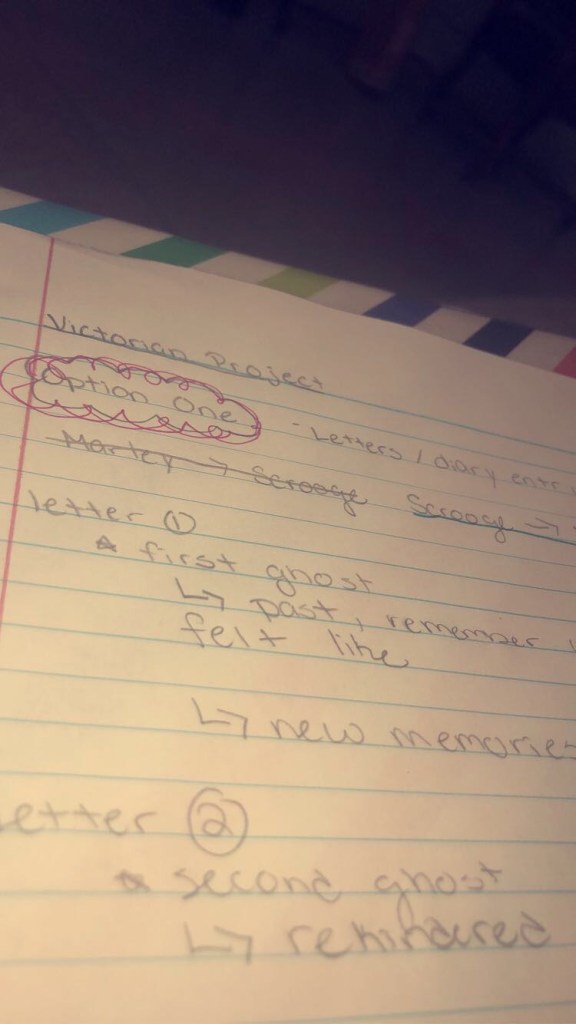
Words of the Past, Present, and Yet to Come
December 27, 1843
Dear Marley,
I heed your warning every day when I wake from slumber. I do not want to become the man that I once was rude and unapproachable. I want to become the man my nephew wants to spend his time on, and a man that people can rely on for business. I know you have long been dead, but I wanted to inform you of my adventures and reckonings with the spirits.
After your frightful visit, I awoke to the clock striking midnight. That is when I first feared for my life. All of a sudden a bright blinding light formed into a figure at the foot of my bed. It was the first spirit. The spirit took me by surprise, for it was gentle and calm. The appearance of the spirit was very bright, “the crown of its head there sprung a bright clear jet of light, by which all this was visible; and which was doubtless the occasion of its using, in its duller moments, a great extinguisher for a cap, which it held under its arm.” (Stave two, 1843). I asked the spirit of its name, it was the Ghost of Christmas Past. We went on a tumultuous adventure Marley! To some of my best lived childhood Christmas’. We went to those when I was a very young boy, all the way to when I appreticed with Old Fezziwig. I was a wonderful time, though it made me realize I had lost my Christmas spirit in some of those times. I have now realized what it takes for me to regain that spirit and kindness.
With sencerity,
Ebeneezer Scrooge
December 28, 1843
Dear Marley,
I have rekindered much of my spirit from spending time with my nephew, Fred. The second ghost that made its appearance showed me what I have been absent from all these years. The Ghost of Christmas Present allowed me to witness the Christmas spirit in the people I spoke to almost everyday. It showed me my nephew’s Christmas party and the games they played. The laughter that filled the room and the warmth that filled everyone’s faces. Even though one game i was the joke it put even more realization upon my life that I needed to experience Christmas cheer.
The second main place the spirit took me to was that the home of my clerk, Bob Cratchit. His family has no wealth, but that did not stop them froming experiencing the joy of Christmas. The small children were so excited for the feast Mrs. Cratchit had prepared, even though it was nt spectacular to my eye. It did not matter to them that they were poor and that their clothes were tattered, and that their feast was not grand; “they were happy, grateful, pleased with one another, and contented with the time” (Stave 3, 1843). Marley, oh dear Marley! I wish you would have been here to witness how grateful I have become for the family I have now. It is wonderful to feel the spirit among them.
With sencerity,
Ebeneezer Scrooge
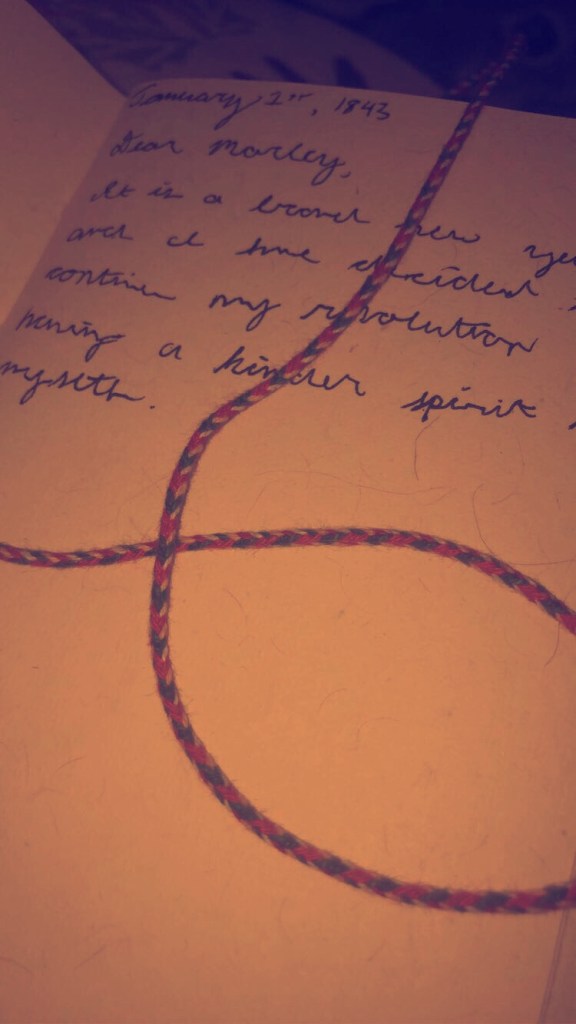
January 1, 1845
Dear Marley,
It is a brand new year and I have decided to continue my resoulution of having a kinder spirit in myself. When the final spirit cam to visit me, the Ghost of Christmas Yet to Come, it showed me of what would be portrayed if I did not change my harsh, impertinent ways. I would be in the same hellish spot as you my dear Marley. My burdens and debts chained to me forever. I do wish you had the chance to better yourself as I did, but I am now grateful for the chance to embrace those around me and to provide Chirstmas cheer when the time is right. Thank you my dear friend for heeding the warning of what would become of me.
With sencerity,
Ebeneezer Scrooge
Works Cited
Dickens, Charles. A Christmas Carol. 1843. Project Gutenberg,
https://www.gutenberg.org/files/46/46-h/46-h.htm. Accessed 29 April 2020.
In Percy Bysshe Shelly’s “Mutability”, the speaker discusses how difficult it can be to convey emotions. Victor Frankenstein often relates to this concept throughout the book. Throughout Frankenstein’s experiment to bring the monster to life, his emotions can often overcome him. Frankenstien’s emotions change constantly, and in “Mutability” it explains the capricious feelings that Frankenstien experiences.
At the beginning of Mary Shelley’s “Frankenstien”, the main character, Victor Frankenstien, was overcome with curiosity to find out the world’s sciences and secrets. Curiosity gets the best of him and he begins to question life itself. Once Frankenstein begins the experiment to bring the monster to life he feels nothing but excitement. This emotion will shortly twist into something darker as the experiment continues.
“Mutability” gives a sense of explanation of the swings of emotion Frankenstein experiences. In the third stanza of the poem, the speaker says that “a dream has the power to poison sleep”. Frakenstien’s “dream” not only damaged, or rather almost destroyed his mental health, it was also affecting his physical health. He was losing sleep, not eating, and not keeping in contact with his close relatives and loved ones. The stress of the experiment was catching up to him and the people around him were starting to get concerned for his sanity.
After Frankenstien finished the experiment, his emotions took a turn for the worst. He becomes miserable with the outcome of the monster. He felt fear as well because he knew he had created a grave mistake that was going to cause consequences. Instead of facing the consequences of the monster, he ran away from them and left the monster clueless into what the situation had become. After Frankenstein got over his sickness he went back to his family in Naples, Italy. What Frakenstein was not aware of was that his creation had followed him and was going to cause much more misery than a little sickness.
In chapter eight of the novel, a tragic event occurred unto which caused Frankenstien’s emotions to skyrocket into something dark. Victor’s creation had followed him home and then in turn murdered his younger brother, William Frankenstien. The event escalated to where the Frankenstein family blamed thier servant, Justine, for the murder of William. This causes Victor to downcast and become thoroughly depressed about the situation. He feels these emotions, along with guilt because he knows who the real killer is, his monster.
In the back of “Frankenstien”, there is a comment section. Mary’s husband Percy Bysshe Shelley makes a very detailed comment about his praises toward his wife’s work. He was “breathless with suspense” as he read the novel. He even compares his own poem “Mutability” in the comment. Percy makes a very valid point about treating others with respect. If Victor had not just accepted the monster, a lot of the consequential events that occured could have been avoided. Percy said that “treat a person il, and he will become wicked.” This is a great explanation for how Frankenstien’s emotions are conveyed through his experiment. If he would have only made mindly decisions instead of the choices he made on emotion, he would have put himself in a better situation.
Shelley, Mary. Frankenstein. Introduction and Notes by Karen Karbiener. Barnes and
Noble, 2003.
Shelly, Percy Bysshe. “Mutability.” The Norton Anthology of British Literature: The
Romantic Period. 10th ed. Stephen Greenblatt, General Editor. W. W. Norton,
2017. pp. 766
The author of Frankenstein, Mary Shelley, married Percy Shelley who wrote the poem Mutability. You can tell from the knowledge and titles of both these works that both Mary and Percy had demons they were fighting in their lives. Mary uses the excerpt from her husband’s poem to try and convey Victor Frankenstein’s feelings and emotions about the deaths of his brother William and Justine Moritz. A line in the poem, “We feel, conceive or reason, laugh or weep;” really brings across the point that Victor does not know how to mourn these deaths. Victor was in such a bad spot himself from the creation of the monster that he was in shock about the deaths the monster caused.
When the audience for the painting Disappointed Love first lays eyes upon the work it seems to draw attention to the young lady sitting alone, conceiving her face for she is sorrowful. The artist, Francis Danby, articulates the woman to be the focal point of the painting. He uses pale and pure colors to illuminate the importance of the woman. Once you look around the painting you can see how dark and gloomy the ambience is around the young lady. This sorrow and gloom can show a connection between the artwork and Mary Shelley’s Frankenstein. The creature Shelly illustrates in her novel continually searches for the love and companionship of its creator, Victor Frankenstein. The young woman represents the creature and how it craves love and affection from others.
Works Cited
Danby, Francis. Disappointed Love. 1821. The Norton Anthology of British Literature: The
Romantic Period. 10th ed. Stephen Greenblatt, General Editor. W. W. Norton, 2018.
C8.
Shelley, Mary. Frankenstein. 1818, 1831. Introduction and Notes by Karen Karbiener.
Barnes and Noble, 2003.
This is an example post, originally published as part of Blogging University. Enroll in one of our ten programs, and start your blog right.
You’re going to publish a post today. Don’t worry about how your blog looks. Don’t worry if you haven’t given it a name yet, or you’re feeling overwhelmed. Just click the “New Post” button, and tell us why you’re here.
Why do this?
The post can be short or long, a personal intro to your life or a bloggy mission statement, a manifesto for the future or a simple outline of your the types of things you hope to publish.
To help you get started, here are a few questions:
You’re not locked into any of this; one of the wonderful things about blogs is how they constantly evolve as we learn, grow, and interact with one another — but it’s good to know where and why you started, and articulating your goals may just give you a few other post ideas.
Can’t think how to get started? Just write the first thing that pops into your head. Anne Lamott, author of a book on writing we love, says that you need to give yourself permission to write a “crappy first draft”. Anne makes a great point — just start writing, and worry about editing it later.
When you’re ready to publish, give your post three to five tags that describe your blog’s focus — writing, photography, fiction, parenting, food, cars, movies, sports, whatever. These tags will help others who care about your topics find you in the Reader. Make sure one of the tags is “zerotohero,” so other new bloggers can find you, too.
Have a WordPress.com account? Log in now.


